If Trust Is the New Currency, How Do You Measure It?
EY calls trust a strategic asset, but most companies still measure it with periodic surveys. Here’s why workplace trust needs continuous, behavioral measurement.

EY says trust is becoming a strategic asset.
Something companies can invest in, build deliberately and use to create competitive advantage.
I agree.
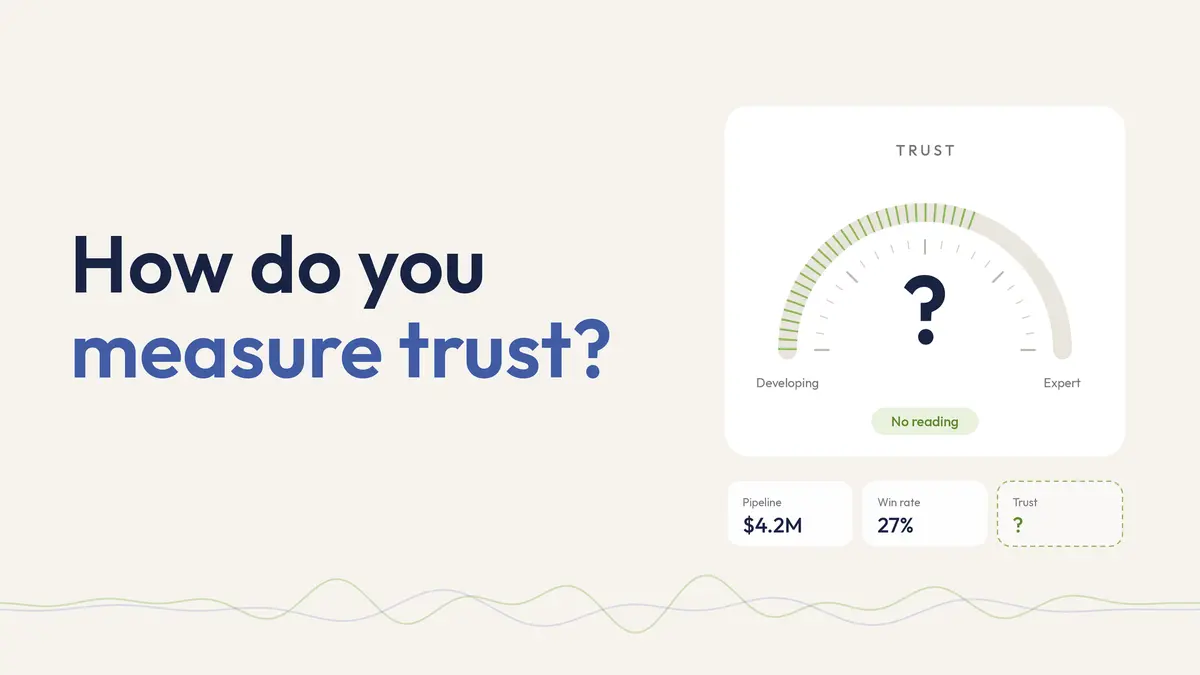
But if trust is really an asset, there is an obvious follow-up question:
How are you measuring it?
That is where things get interesting.
EY recently published a piece in its Megatrends series arguing that trust has moved beyond a compliance obligation and into the strategy conversation.
The evidence behind that argument is hard to ignore. Trust in technology has fallen sharply over the past decade. EY cites analysis suggesting companies can lose roughly 30% of their value when trust erodes.
And the gap between how organizations see themselves and how the people they serve experience them is getting harder to dismiss.
The 64-to-32 trust gap
One number in EY’s research stood out to me.
Sixty-four percent of consumers say AI security breaches are a major concern.
Only 32% of C-suite executives say the same.
That is a 32-point gap between the people running organizations and the people those organizations exist to serve.
I’ve spent most of my career looking at another version of that same gap.
Most sellers believe they are trusted advisors to their customers.
Far fewer customers agree.
Different function. Different research.
Same problem.
The person on one side of the relationship believes the relationship is stronger than the person on the other side does.
Nobody has to be careless or dishonest for that to happen.
It is what happens when the only instrument pointed at a relationship is the opinion of the person standing inside it.
EY’s Trust Stack has a measurement problem
EY organizes trust into four layers.
At the foundation are policies and processes, including governance, risk and compliance.
Above that are protocols and platforms, including technologies designed to make systems more trustworthy.
Then come profit mechanisms, where business models and incentives are aligned with trustworthy outcomes.
At the top sits people and psychology: leadership behaviors such as transparency, accountability, vulnerability and inclusion.
It is a useful model.
But put the same question to every layer:
How would you know whether it is working?
Policies and processes get audited. There is a control, a test and an owner.
Platforms get instrumented. Companies monitor uptime, failures, security incidents and model drift.
Business models get modeled and measured. Eventually the P&L tells you whether the assumptions held up.
Then we reach people and psychology.
And suddenly the measurement system becomes a survey.
Usually once or twice a year.
Often weeks or months after the interactions it is supposed to help leaders understand.
Every other layer of that stack would reject a control that weak.
Why surveys cannot carry the whole load
Employee engagement surveys have value.
But they were never designed to be a continuous measurement system for trust.
There are three basic problems.
First, they rely heavily on recall.
Someone is being asked in October to summarize how they experienced conversations, decisions and managers over the previous six months.
Human memory simply does not work with that kind of precision.
Second, surveys are periodic in a workplace that changes every week.
A relationship can deteriorate over three meetings. A manager can lose a team’s confidence in a month. A customer can disengage halfway through a call.
By the time an annual or semiannual survey captures the problem, the organization may already be explaining a resignation, a lost deal or a disengaged team.
And third, surveys are self-reported inside a power structure.
Employees know who controls promotions, compensation and opportunities.
Customers know who owns the commercial relationship.
People do not always answer the question exactly as they experience it. They answer the question they feel safe answering.
That is how perception gaps survive.
Turning trust from a feeling into a signal
This is the problem we built Relate to address.
Relate analyzes both the language of a conversation and how that language is delivered.
It measures vocal and behavioral signals and maps them against the Trust Equation, the research-backed framework developed by Trusted Advisor Associates.
Instead of producing only another meeting summary, Relate gives individuals and teams a consistent way to see how communication patterns and trust behaviors change over time.
That distinction matters.
A survey tells you how someone remembers feeling.
A measurement system gives you a signal close to when the behavior actually happened.
Neither replaces the other.
But one gives leaders the opportunity to intervene while there is still something to change.
If trust is an asset, treat it like one
EY cites analysis suggesting that roughly 30% of company value can disappear when trust breaks down.
Think about that for a moment.
If another asset carried that much enterprise value, would the organization check it twice a year?
Probably not.
There would be a dashboard.
There would be an owner.
There would be a trend line.
There would be thresholds that triggered action.
Yet trust, something leaders routinely describe as essential to employees, customers and company reputation, is still largely managed through surveys, engagement scores and instinct.
That gap is becoming harder to justify.
Especially now that AI is moving into more of the conversations where trust is created or lost.
EY has made the strategic case: trust belongs in the same conversation as growth, resilience and competitive advantage.
The next question belongs to operators.
If trust is an asset, what is yours worth today?
And more importantly:
How would you know if it changed tomorrow?
Start with your own team
You do not need a new dashboard to start asking better questions about trust.
Our Work Relationship Health Check gives you a quick view into the strength of the relationships on your team and where there may be room to improve.