7 in 10 Workers Are Disengaged. Nobody Managed the Change.
Seven in ten U.S. workers aren’t engaged, a 15-year low. Layoffs, reorgs and leadership shocks broke trust. Here’s how leaders rebuild it, without a survey.

Layoffs, reorgs, a founder gone overnight, and not a change plan behind any of it. No wonder your people have whiplash.
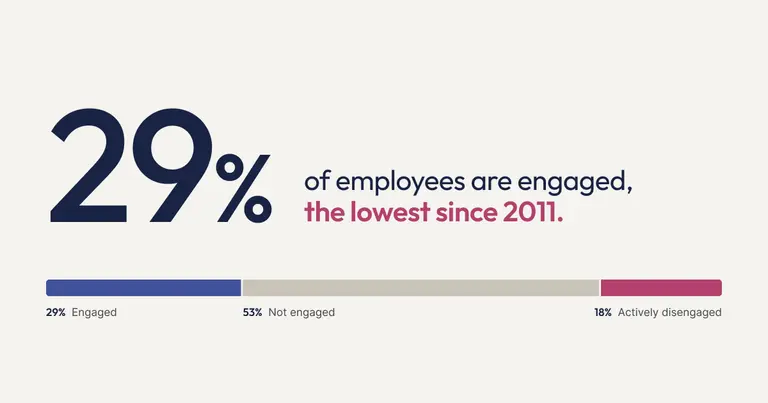
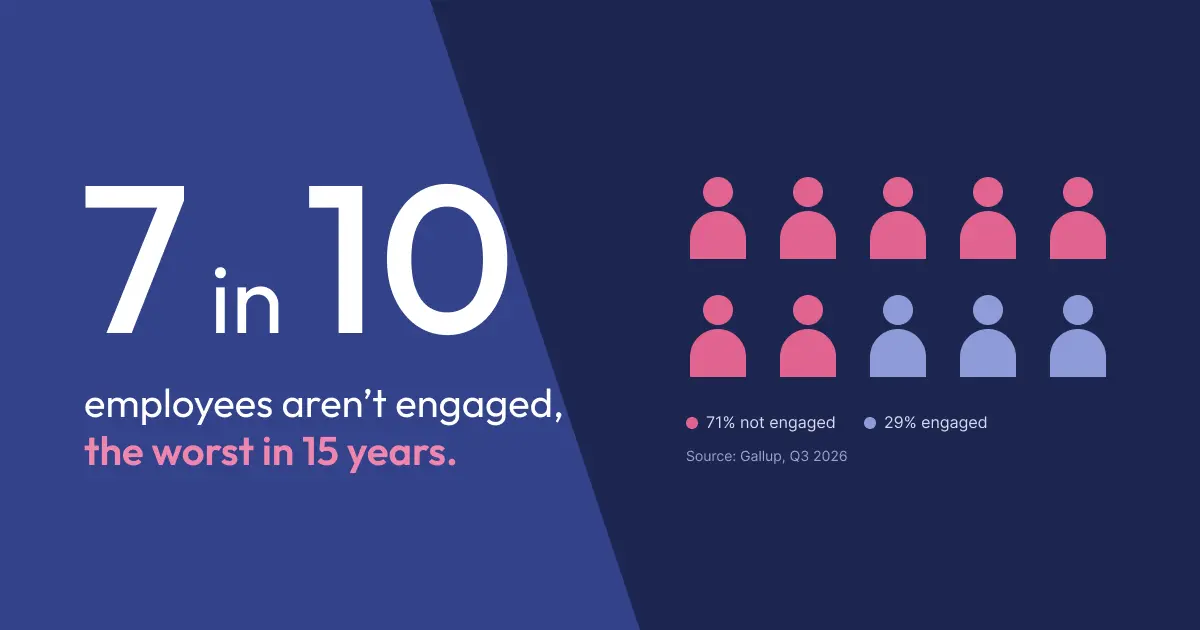
Roughly seven in ten people at work right now are not engaged. That’s Gallup’s read for the third quarter of 2026: 53% not engaged and another 18% actively disengaged. Put the other way, only 29% of U.S. employees are engaged, the lowest level Gallup has recorded since 2011. Each percentage point is about 1.6 million workers, and there are roughly 11 million fewer engaged employees today than in 2020. Gallup puts the cost of all that disengagement at close to $2 trillion a year in lost productivity.
The year people lost the thread
Amazon cut about 16,000 corporate roles in October and pointed to AI and efficiency. Microsoft let 4,800 people go in July and then put “voluntary exit” offers in front of 60,000 more. Meta, PayPal and Intel ran their own reductions. A Microsoft executive said the quiet part plainly: the roles being eliminated are not being replaced by AI, but the way the work gets done is changing underneath everyone’s feet.
Then look at the other end of the market. Nvidia is not cutting anyone. It is the most valuable company in the world, hiring and printing records. And last week its people woke up to find Jensen Huang gone, resigned overnight amid scandal, with his longtime CFO installed as interim chief and a board signaling it will not bring him back. No layoff touched them. Their jobs are safe. What vanished was certainty. The founder who had run the place for three decades was gone in a single news cycle, and a leadership vacuum opened where the steadiest seat in tech used to be.
That is the uncomfortable part for every leader reading this. Engagement is sliding at the companies that are winning, too. Reorgs, acquisitions, a scandal at the top, new reporting lines, return-to-office mandates, a manager who changed twice in a year. People do not disengage only because the news is bad. They disengage because they have stopped feeling any control over what happens next.
That is the real story behind 29%. It is a crisis of trust and agency, and it is hitting the layoffs and the booms at the same time.
Why the survey can’t see this one coming
Here is what most companies will do about a 15-year low. They will run the annual engagement survey.
Think about the timing. A survey measures how people felt the week they filled it out. The results land a quarter later, after they have been cleaned, benchmarked and turned into a slide. By the time a leader reads that a team is struggling, the manager has already left, the reorg has already happened, and the two people who checked out weeks ago have already updated their resumes.
It gets worse in a year like this one. Response rates were already falling before the layoffs. Ask people to rate their trust in leadership two weeks after a reduction and watch what happens. Nobody tells the truth on a form that HR owns right after their colleagues were let go. The survey does not just arrive late. It arrives into a room where honesty has become a risk.
A weather report from last spring cannot help you with the storm that is happening now.
Move fast and break things, and the thing that breaks is people
“Move fast and break things” was always a line about software. Somewhere in the last few years it became the operating model for the whole company. Ship the reorg, break the org chart, patch it next quarter. The problem is that the thing breaking is not a feature flag. It is people, and people do not redeploy.
Trust is the slowest asset a company has. It is built in small, boring increments and spent in a single afternoon. You can change a strategy overnight. You cannot change a strategy overnight and keep trust unless you manage the change on purpose, and most of this year’s change had no plan attached to it at all.
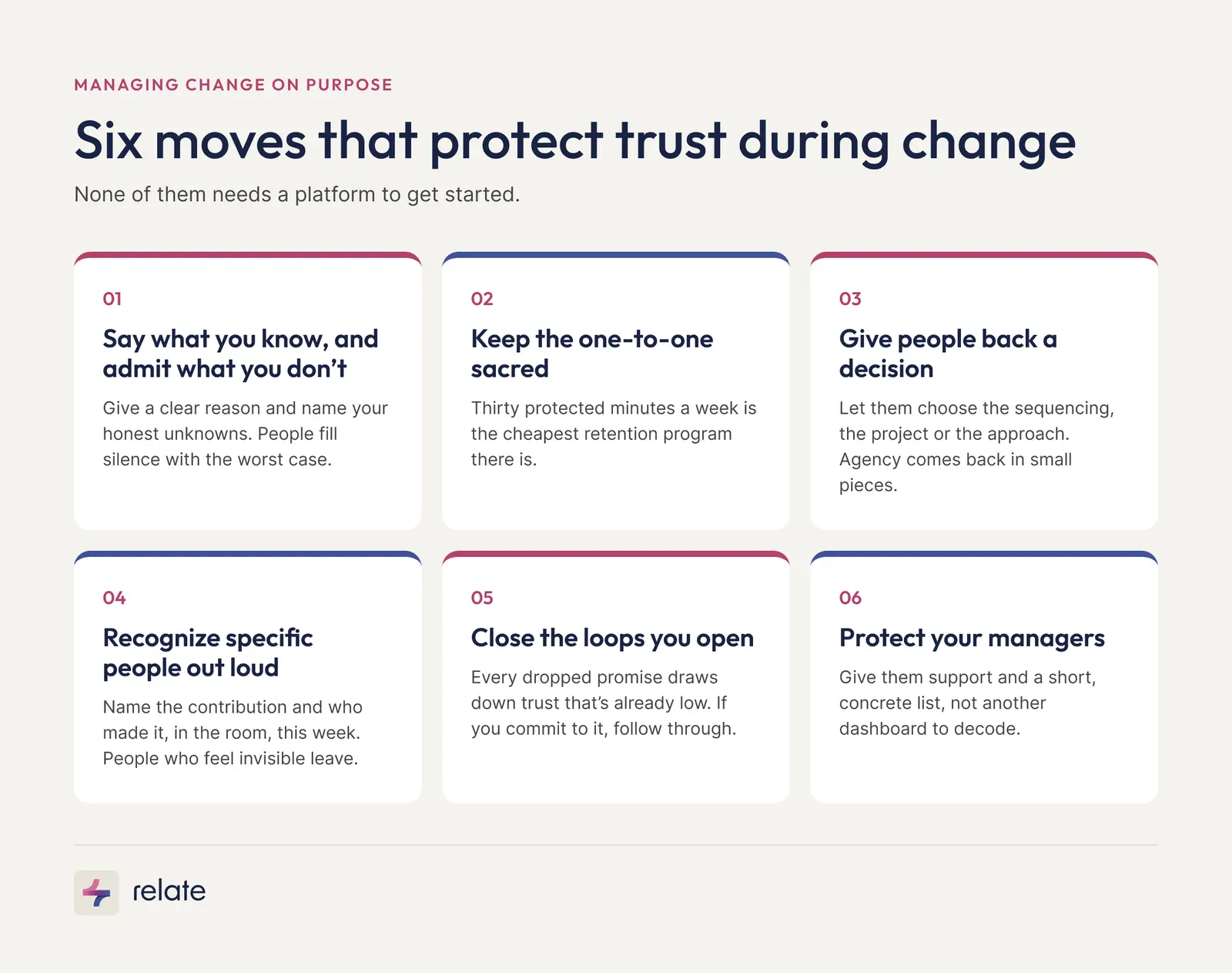
Here is what managing it on purpose looks like, and none of it requires a platform to start:
Say what you know, and admit what you don’t. A reorg announced with a clear reason and three honest unknowns beats a polished message that pretends everything is already decided. Silence is what people fill with the worst-case version.
Keep the one-to-one sacred. It is the first thing to slip when things get busy and the last thing that should. Thirty protected minutes a week is the cheapest retention program in existence.
Give people back a decision. When the big things are out of someone’s hands, hand them a small one: how the work gets sequenced, which project they take, how a deadline gets met. Agency is what whiplash takes away, and it comes back in small pieces.
Recognize specific people out loud. In a reorg, people feel invisible, and invisible people leave. Name the contribution and the person who made it, in the room, this week.
Close the loops you open. Every promise made during change and then dropped is a withdrawal from an account that is already low. If you commit to it, cover it.
Protect your managers. They are catching the whiplash from above and passing it down without a script. Give them support and a short, concrete list of what to do with their teams, not another dashboard to decode.
 None of that is complicated. It is the normal, human way companies used to absorb change before “break things” became a value. The reason it stopped is not that leaders got crueler. It is that in the middle of layoffs and reorgs, nobody can see which teams are breaking until the resignation lands.
What actually rebuilds engagement
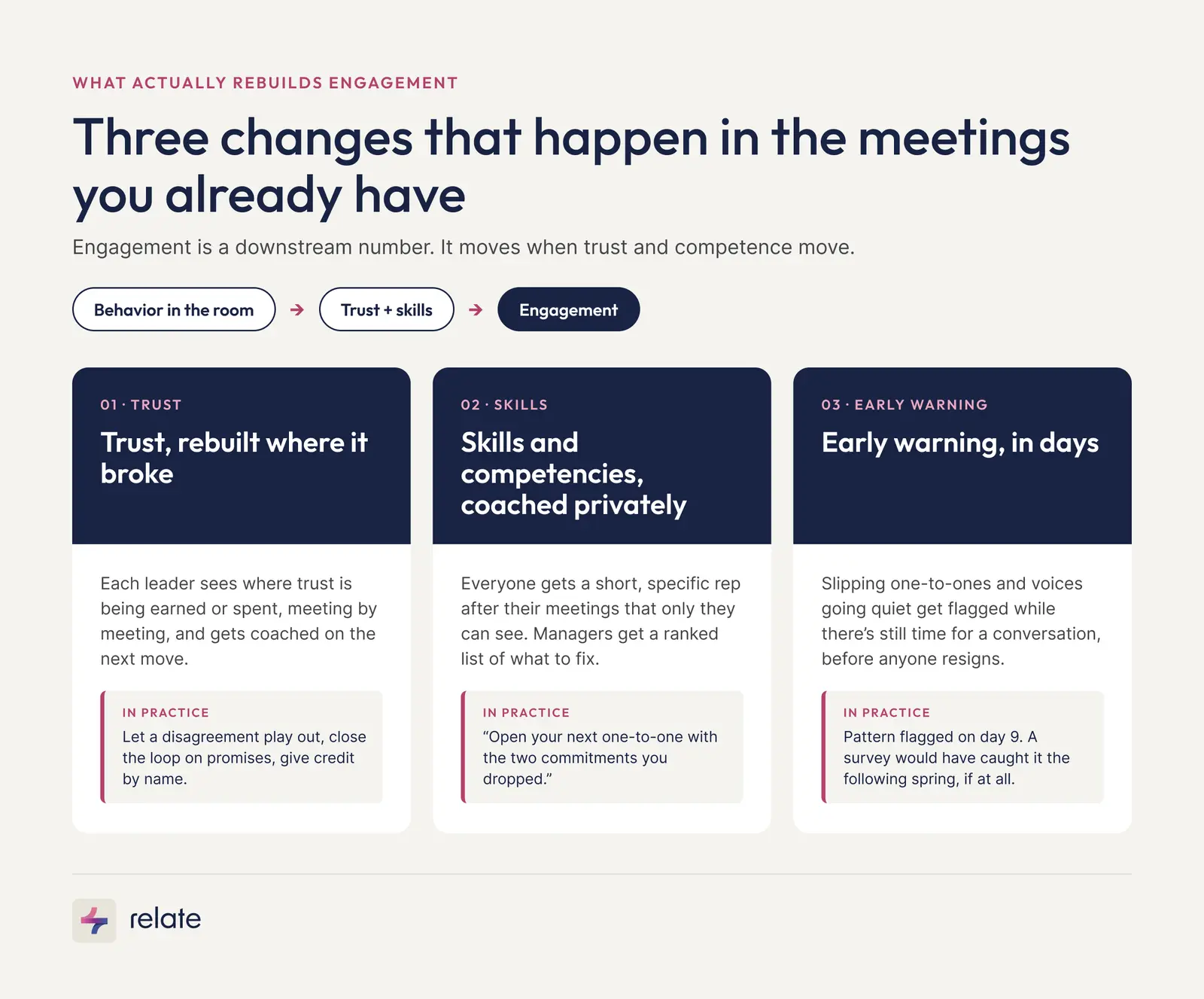
Engagement is a downstream number. It moves when trust is rebuilt and when people get better at the work and the relationships around it. Those two things, trust and competence, are not built in a survey window. They are built in the meetings your teams are already having, every day, whether anyone is measuring them or not.
That is where Relate works. Sandi, our AI analyst, joins the Zoom, Teams and Meet calls your people already run. Sandi reads behavior rather than opinions: who is getting talked over, whose one-to-ones are slipping, whether commitments from last week ever got closed, whether anyone’s contribution gets named out loud. Sandi scores it against the Trust Equation, twenty-five years of research from the team behind The Trusted Advisor, and returns a continuous engagement read for every person, every manager and the whole company. No form. No survey season. No response rate to chase.
The read is the easy part. The change is what matters.
Trust, rebuilt where it broke. After a layoff or a reorg, trust does not come back because leadership sends a message. It comes back in the small behaviors inside daily meetings: letting a disagreement live instead of steamrolling it, closing the loop on what was promised, giving credit by name. Relate shows each leader exactly where their trust score is being earned or spent, meeting by meeting, and coaches the next move.
Skills and competencies, coached privately. Sandi gives every person a short, specific rep after their meetings, seen only by them. Let the pushback breathe for sixty seconds. Open your next one-to-one with the two commitments you dropped. Name the contribution and who made it. Managers get a ranked list of what to fix with their team, drawn from what actually happened rather than what a form guessed. This is manager capability built in the flow of work, which is the single factor Gallup ties most tightly to engagement.
Early warning, in days. When a team’s one-to-ones start slipping or voices go quiet after a reorg, Relate flags it while it is still a conversation, not a resignation letter. In one case the pattern showed up on day nine. A survey would have found it the following spring, if at all.
The point
29% percent is not a measurement problem. Measuring it again, more often, with a better survey tool, does not move it. People are disengaging because change is happening to them and trust has thinned out, at the companies cutting jobs and at the companies that cannot hire fast enough.
You rebuild from the same place either way: the behavior in the room. Relate reads it, scores it, and coaches it, continuously, for everyone, without asking a single person to fill out a form.
Your engagement survey is a year behind. The people you are trying to keep are deciding right now.