Employee Engagement Hits 29%: Why Annual Surveys Aren't Enough
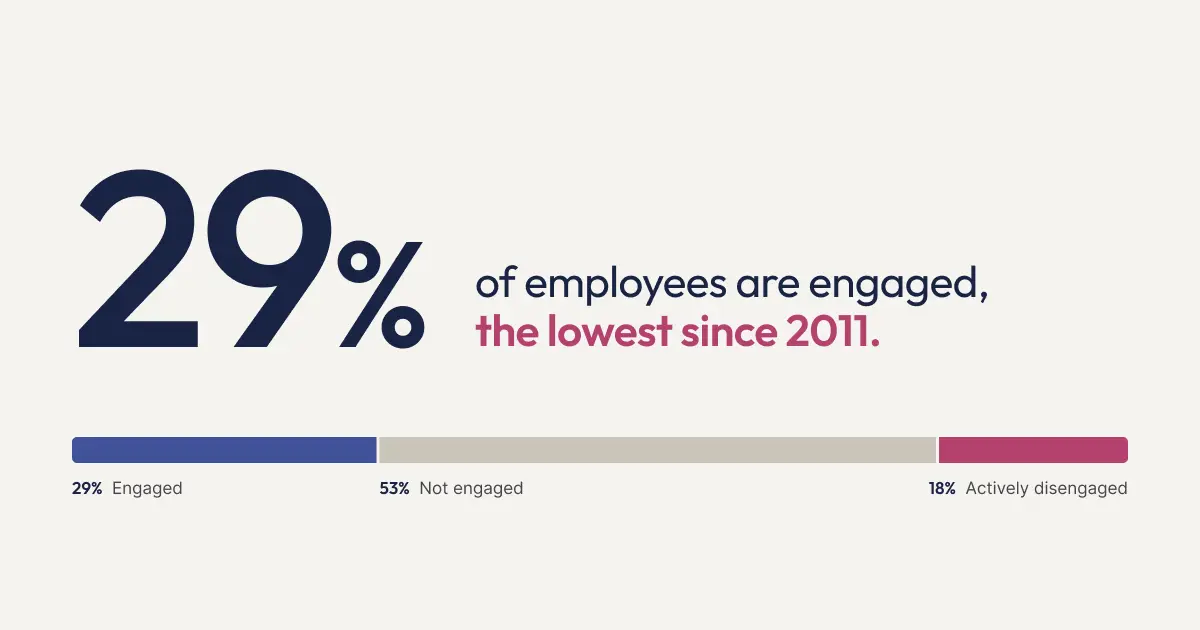
Gallup reports employee engagement at a 15-year low of 29%. Learn why annual surveys miss early warning signs and how continuous engagement intelligence helps.

Gallup surveyed 21,648 working Americans between August 5 and 19 and published on October 28. Engagement came back at 29%, the lowest reading since 2011.
These are the 5 numbers worth your time.
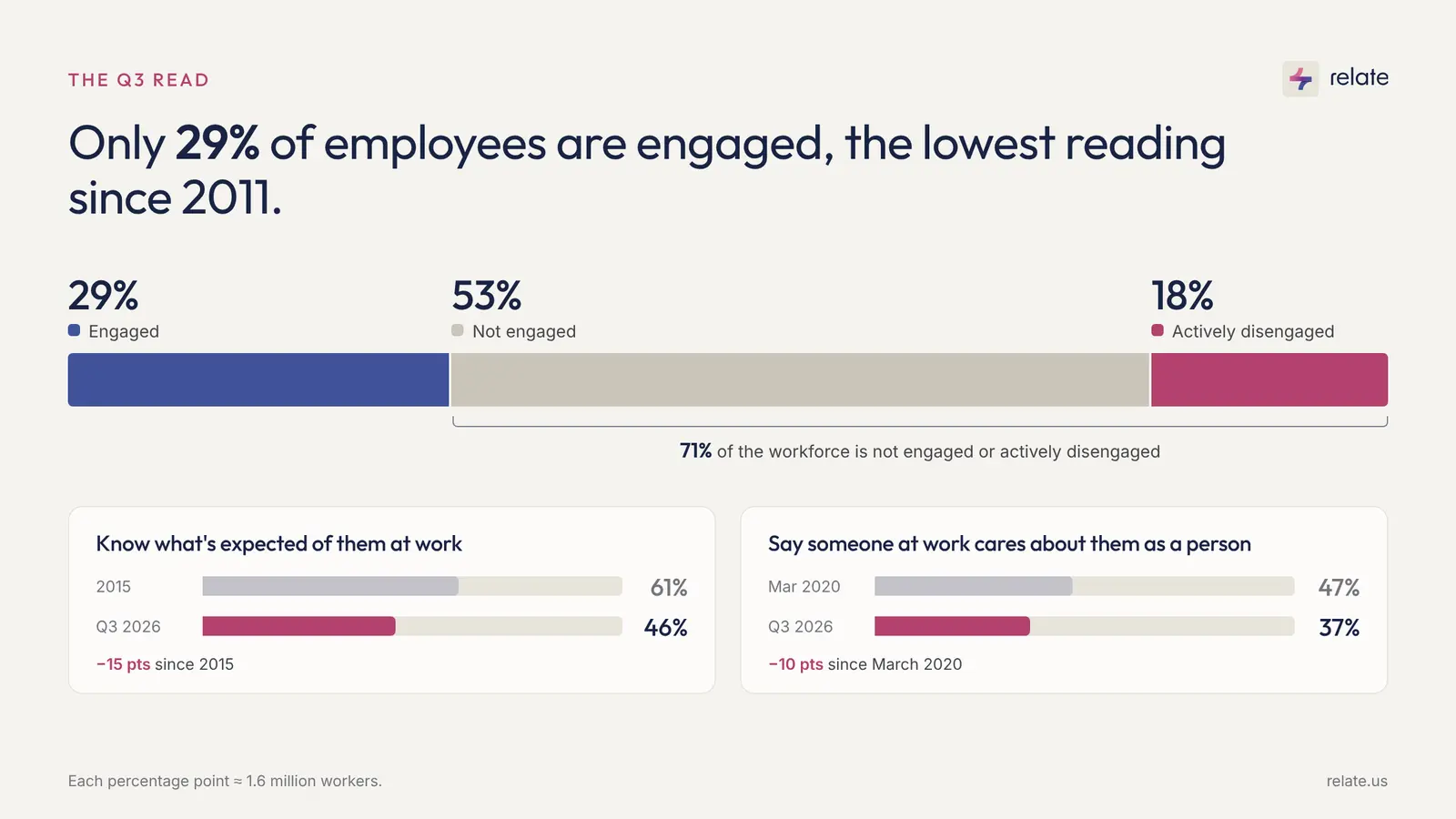
The bottom 2 are the ones to look at
Knowing what is expected of you is not a feeling. It is whether somebody said who is doing what by when, out loud, and then came back to it.
Somebody caring about you at work is not a feeling either. It is whether the 1 on 1 happened, and whether you got to finish a sentence in it.
Both of those happen in a meeting, on a particular day, and both can be observed the week they change.
I have been on the other side of this. I was a CHRO. I built the engagement program, fielded the survey, presented the results and believed them. Mostly green, 1 amber we were watching. Then somebody good resigned in the spring and the exit interview said their manager had stopped doing 1 on 1s months earlier. Nobody had lied on the survey. The survey was not built to find it.
How long it takes to reach you
ISay a manager stops doing 1 on 1s in November. Here is the sequence under an annual or twice-yearly cycle.
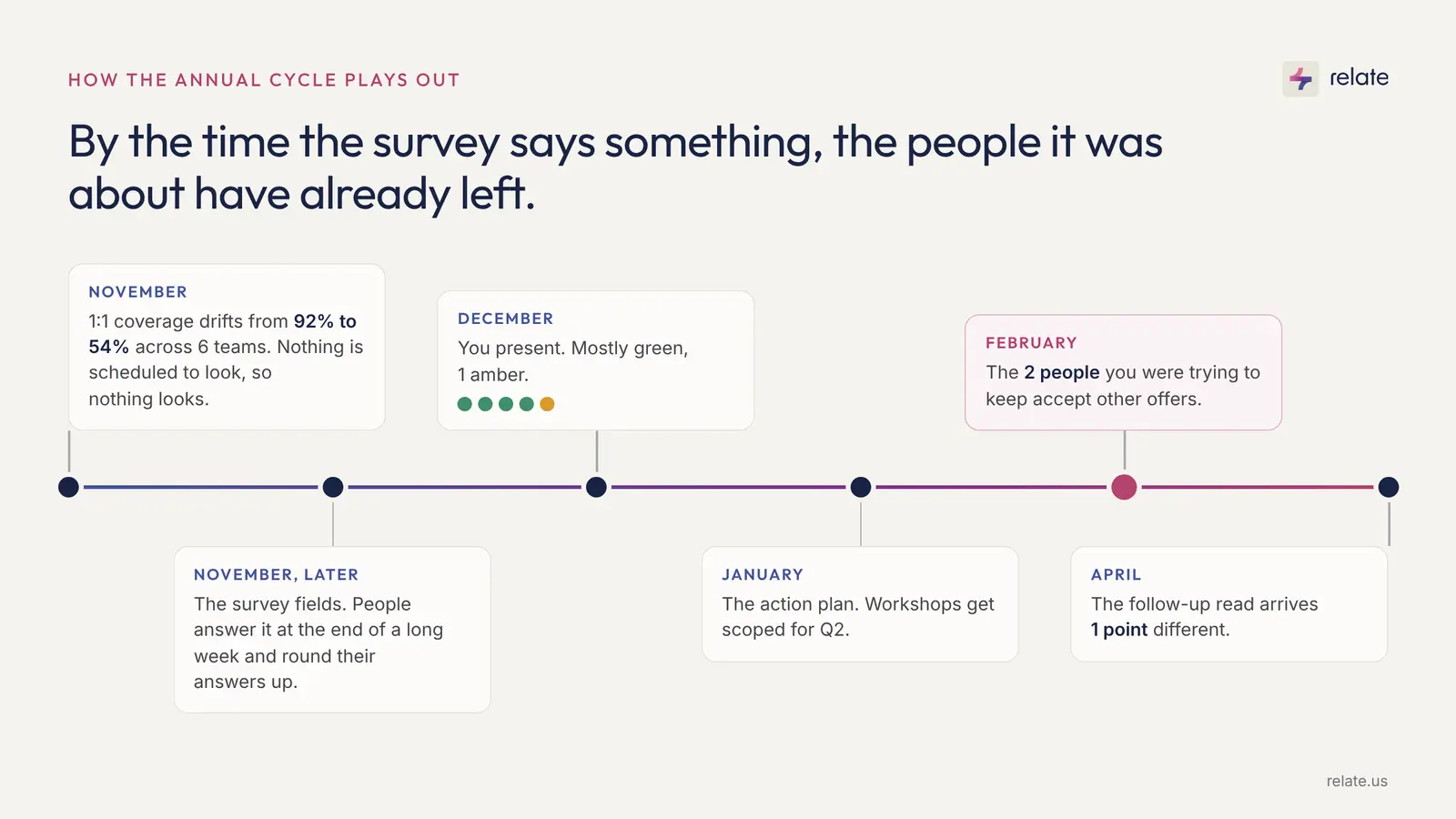 5 months between the behavior changing and the number reaching you. The decisions it was meant to influence were made in month 4.
What Relate does about each one
1. People do not know what is expected of them
Relate reads whether commitments get made out loud, with an owner and a date, and whether they close. When follow-through drops on a team, you get the team and the day it started.
2. People do not feel anybody cares
It reads 1 on 1 coverage, who talks and for how long, whether people get to finish, and whether anybody asks before they tell. Nobody fills anything in. It is already in the calendar and in the meeting.
3. You find out too late
Day 9 for Product. Day 19 for Engineering. Day 44 for Operations. Those are the days a behavior changed, with a quarter left to act on it.
4. Nobody knows what to do with the number
Sandi gives the manager the behavior, the owner and the week. 1 thing to try, 90 seconds, inside a meeting already on their calendar. The following week it reports whether it moved, with the numbers.
5. Nobody wants to fill anything in
There is no survey. No forms, no reminder emails, no response rate to chase, and no 40 minutes at the end of a Friday deciding how honest to be.
6. Measurement and development sit in 2 budgets
In Relate they are 1 system. What gets measured is behavior, and the development is a rep on that behavior.
The finding that did not get picked up
There is a second result in the same release that is bigger than the headline.
Where people have adopted AI at work, 3 conditions move engagement. A clear plan from leadership adds 15 points. Manager support adds 18. Where all 3 are in place, engagement reaches 53%.
Manager support is the largest single lever in that data. It is also the thing an annual survey measures last, because by the time it is fielded the behavior that drove the answer happened months earlier.
If your 2027 AI plan treats managers as one workstream among several, the Gallup data says to reweight it.
Takeaways
IF YOU ARE THE CEO OR FOUNDER
• Ask how old your engagement number is on the day you read it. If it is 5 months old, it describes a quarter you have already closed.
• Ask which department sits furthest below the company average, and what day it started moving. Without a date, the number is not operational.
• Weight managers in your AI plan the way the data weights them. 18 points.
IF YOU ARE THE CHRO OR HEAD OF PEOPLE
• Bring the department, the behavior, the day it started, and the cost of another quarter of it. That is a different conversation than a heat map.
• Before signing a 2027 renewal, write down 2 dates. When the next report reaches you, and when the behavior it describes happened. Put both in the business case.
• If a vendor cannot tell you what a manager should do differently this week, the product measures and does not develop.
IF YOU ARE A MANAGER
• 46% of people cannot say what is expected of them. Closing your next meeting with who is doing what by when, out loud, and opening the one after it with what you committed to, moves that number.
• Ask 1 open question and leave 3 seconds of silence after it.
What it costs to wait
A renewal is a cost line. The other side of it is worth pricing.
A department at 54% 1 on 1 coverage for a quarter is a retention exposure. Replacing a mid-level person runs roughly 1.5 to 2 times salary once you count the vacancy, the recruiting and the ramp. 2 of those is most of a platform renewal.
If that department also ships 40% of the roadmap, it is a delivery date problem as well.
Take the retention number and the delivery number into the conversation, with the date the behavior started.
Buying season
29% accumulated. 1 skipped 1 on 1 at a time, inside 90 day windows where nothing was looking.
It is November, and a lot of teams are deciding what to renew for 2027. If what you are about to sign reports in March on how people felt in November, you are buying a record of a quarter you can no longer change.
Stop paying for the past.
Measure continuously, and develop people inside the meetings they are already in.
If you want to see it
Relate is free to start. I am happy to walk anybody through it, including teams renewing with someone else. If you are mid-procurement and you want a second read on what is in front of you, that is worth a conversation either way. Book a demo.